
Hydrogen sulfide (H2S) is one of the most corrosive and odorous contaminants found in biogas, landfill gas, natural gas and industrial waste gas streams. It attacks pipelines and compressors, shortens catalyst life, and creates serious workplace health and environmental concerns. For decades, impregnated activated carbon has been one of the most reliable and cost-effective solutions for polishing H2S down to trace levels before the gas is used or released.
Why H2S Must Be Removed Before Use
H2S is highly reactive and acidic. When it dissolves in the moisture commonly present in gas streams it forms weak sulfuric acid, which corrodes stainless steel and carbon steel alike. Downstream equipment such as engines, turbines, fuel cells and catalytic converters can be poisoned or damaged by even a few parts per million. Beyond equipment damage, H2S has a characteristic rotten-egg smell detectable at very low concentrations, which creates odour complaints around facilities and exposes operators to health risks.
How Impregnated Activated Carbon Works
Standard activated carbon removes H2S by physical adsorption, which works well only at high concentrations. Impregnated carbon goes a step further: the carbon surface is treated with reactive chemicals — commonly potassium hydroxide (KOH), sodium hydroxide (NaOH) or iron oxides — that convert adsorbed H2S into sulfur, sulfate or iron sulfide. This chemical conversion shifts the equilibrium so the carbon keeps adsorbing far more H2S than a plain carbon ever could, and it prevents the release of adsorbed H2S when operating conditions change.
For demanding applications, JYD supplies a dedicated iron oxide desulfurizer with a saturation sulfur capacity of 550–800 mg/g and outlet H2S precision below 0.5 ppm, as well as alkali-impregnated pellet carbon (3 mm, 4 mm) for general biogas and odour control.
Selecting the Right Grade
Three factors matter most when choosing impregnated carbon for H2S removal:
1. Type of impregnation. Alkali-impregnated carbon suits moderate H2S loads and frequent media replacement; iron oxide desulfurizer suits high, steady H2S loads and long service life.
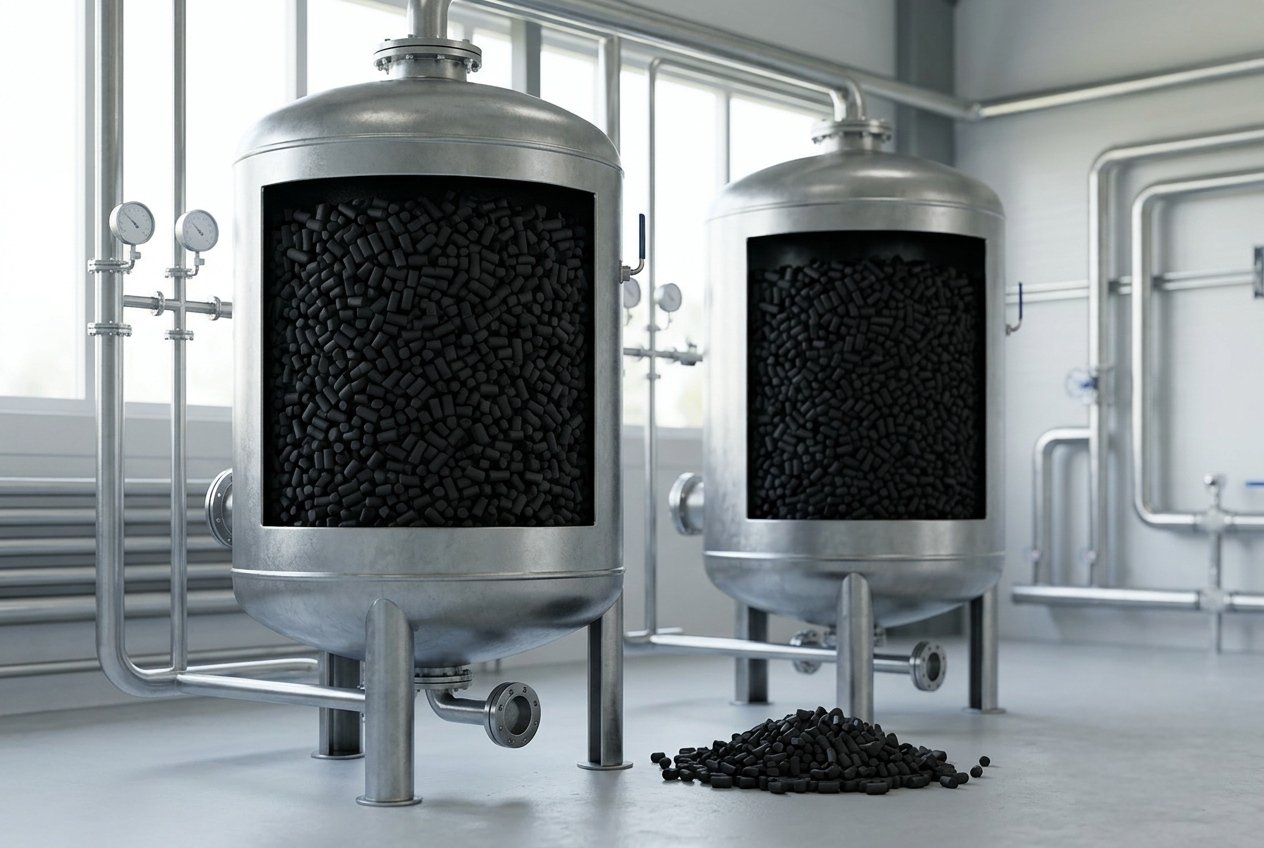
2. Physical form. Pellet carbon (3–4 mm diameter) gives low pressure drop and high mechanical strength, ideal for fixed-bed vessels. Granular grades work where dusting must be minimised.
3. Feed gas conditions. Relative humidity between 40–80% improves the chemical reaction; very dry or very wet gas needs pre-treatment. Temperature should normally stay below 60 °C for best capacity.
Monitoring, Change-Out and Safety
Once an H2S bed is in service, a simple monitoring routine keeps it performing. Test the outlet H2S weekly at first, then adjust frequency to the feed quality you observe. Rising outlet H2S, growing pressure drop across the vessel, or visible caking on the top of the bed all signal that change-out is approaching. Record bed life and throughput so you can forecast the next replacement accurately instead of reacting to a breakthrough.
Safety deserves the same attention as performance. Because H2S is toxic even at low concentrations, ventilate around the vessel, fit gas detection where operators work, and follow proper confined-space procedures during media change-out. Spent media should be handled according to local waste regulations — the sulfur compounds loaded onto the carbon determine its classification.
FAQ
How long does impregnated carbon last in H2S service?
Lifespan depends on H2S concentration, gas flow rate and bed size. In typical biogas duty with 200–1000 ppm H2S, a correctly sized bed lasts 6 to 24 months before replacement.
Can impregnated carbon be regenerated?
Some iron-oxide-type media can be regenerated with steam or air stripping under controlled conditions. Alkali-impregnated carbon is usually spent and replaced once the outlet H2S rises above specification.
Does JYD provide free samples for H2S testing?
Yes. JYD supplies free trial batches with datasheets so you can verify removal performance in your own gas stream before ordering.
To size an H2S removal bed for your biogas or waste gas, send us your gas composition, flow rate and outlet requirement — our engineers will recommend the right grade, bed volume and vessel configuration within 24 hours.