
Industrial water treatment demands more from a filter media than municipal service. High flow rates, heavy organic loads and aggressive operating conditions quickly punish weak or dusty carbon. Coal-based pellet (extruded) activated carbon is engineered for exactly these conditions: it combines the high adsorption capacity of coal carbon with the mechanical strength of a formed product, and its uniform cylindrical shape keeps pressure drop low across the bed.
Why Pellets Beat Granular Carbon in Many Industrial Beds
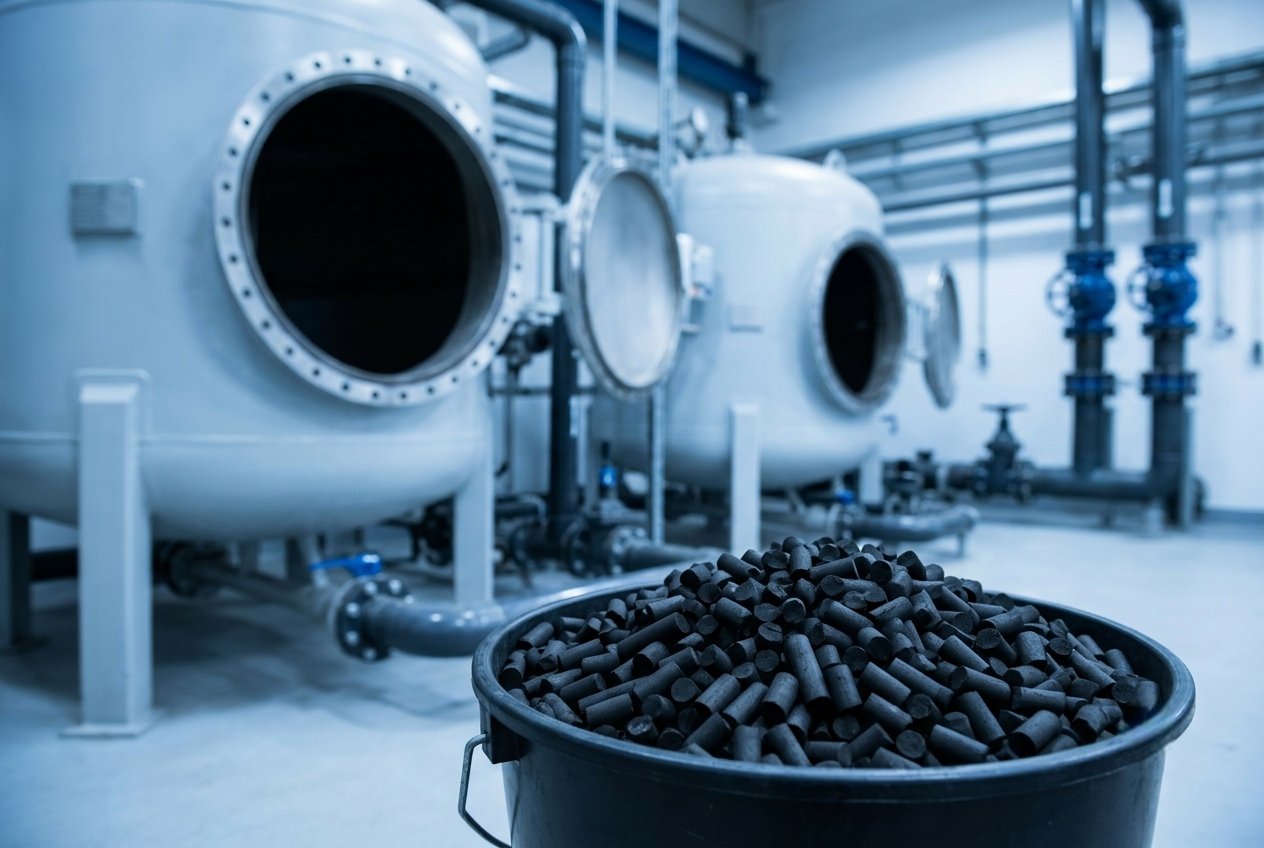
Pellet carbon is made by extruding coal-based powder into uniform rods, typically 0.9 mm to 8 mm in diameter. The regular shape gives a consistent void fraction, which means stable flow distribution and predictable pressure drop over the life of the bed. The high crushing strength (≥93–97% hardness) resists attrition during backwashing and media handling, so fewer fines are generated and downstream equipment stays clean. For processes that run continuously for months, this translates directly into lower maintenance and longer media life.
Common Industrial Applications
JYD coal pellet carbon is widely used for:
Wastewater polishing — removing residual COD, colour and micropollutants after biological treatment.
Cooling water and boiler make-up — protecting reverse osmosis membranes and ion-exchange resins from organic fouling.
Process water — decolorization and deodorization in chemical, pharmaceutical and food plants.
Groundwater remediation — treating contaminated groundwater in pump-and-treat systems.
Selecting Diameter and Grade
Larger diameter pellets (4–6 mm) offer lower pressure drop and suit high-flow, low-concentration duties; smaller pellets (0.9–2 mm) give faster adsorption kinetics for higher loadings. Standard grades range from 700 to 1100 mg/g iodine value, with CTC values from 30 to 90% for gas-phase duties. For water service, a high iodine value with a moderate CTC is usually the right balance.
Bulk Density and Vessel Design
Pellet carbon's bulk density — typically 450 to 650 g/L depending on grade — is higher than many other media, which has practical consequences for vessel design. Make sure your supports and underdrain system are rated for the additional static load, and leave enough freeboard for the bed to expand during backwash. The uniform cylindrical shape gives predictable pressure drop, so you can size pumps and backwash flows from published pressure-drop curves rather than guessing.
When filling a new bed, do it slowly and avoid pouring carbon from height, which can crush pellets or segregate them by size. A wet fill method — flooding the vessel and adding carbon through a water seal — reduces dust and cushions the media. Because pellet carbon is easily fluidised, control the backwash flow within the range recommended for the specific diameter; over-fluidisation wastes energy and can carry media into the collector system.
FAQ
What backwash rate do pellet carbon beds need?
Pellet carbon has a relatively high bulk density (450–650 g/L), so it needs a strong backwash — typically 15–25 m/h — to clean and reclassify the bed. Confirm the vessel design before ordering.
Can pellet carbon be thermally regenerated?
Yes. Coal pellets tolerate repeated thermal regeneration well, which lowers the lifetime cost of the media in large installations.
Do you supply pellet carbon with a 25 kg or bulk package?
JYD supplies 25 kg woven bags, 500 kg jumbo bags and loose bulk by container, with packaging matched to your handling equipment.
Send your flow rate, contaminant load and vessel dimensions to JYD for a pellet carbon recommendation and free sample.